
IRON WOLVES // PROJECT THOR
Your hardware. Your command.
A local-first AI command center built to create, reason, research, automate and work alongside you on your hardware, under your control.
 THORCOMMAND CENTER
IRON WOLVES // PROJECT THOR
A local-first AI command center built to create, reason, research, automate and work alongside you on your hardware, under your control.
WHY THOR EXISTS
After a stroke in 2024 permanently limited use of the left side of my body, I was still waiting on disability support and could not sustain the subscriptions, credits and recurring costs of commercial cloud AI.
I still needed the tools. I wanted to create, learn, work and build something of my own, so Thor began on an aging PC with limited money, limited hardware and no assumption that more cloud credits would solve the next problem.
The first goal was simple: build a streaming co-pilot and creative assistant that could run beside the rest of my software. Very quickly, that constraint became a larger engineering idea. Thor had to stay lightweight, adapt to the hardware actually available, release resources when work was finished, route expensive tasks selectively and use stronger models only when the mission justified them.
Efficiency is not a buzzword here. It was a survival requirement.
That changed the mission. Thor could become a path into capable AI for people who do not have enterprise hardware, unlimited money or AI engineering expertise. The goal is a personal local AI command center that can grow with the PC you already own instead of putting the price of admission behind a permanent cloud bill.
LISTEN TO WHAT I MEAN, NOT WHAT I SAY. The Captain should not need schemas, exact field names, perfect grammar or prompt-engineering expertise. Thor translates human intent into strict internal structures.
WORKING PROTOTYPE TODAY
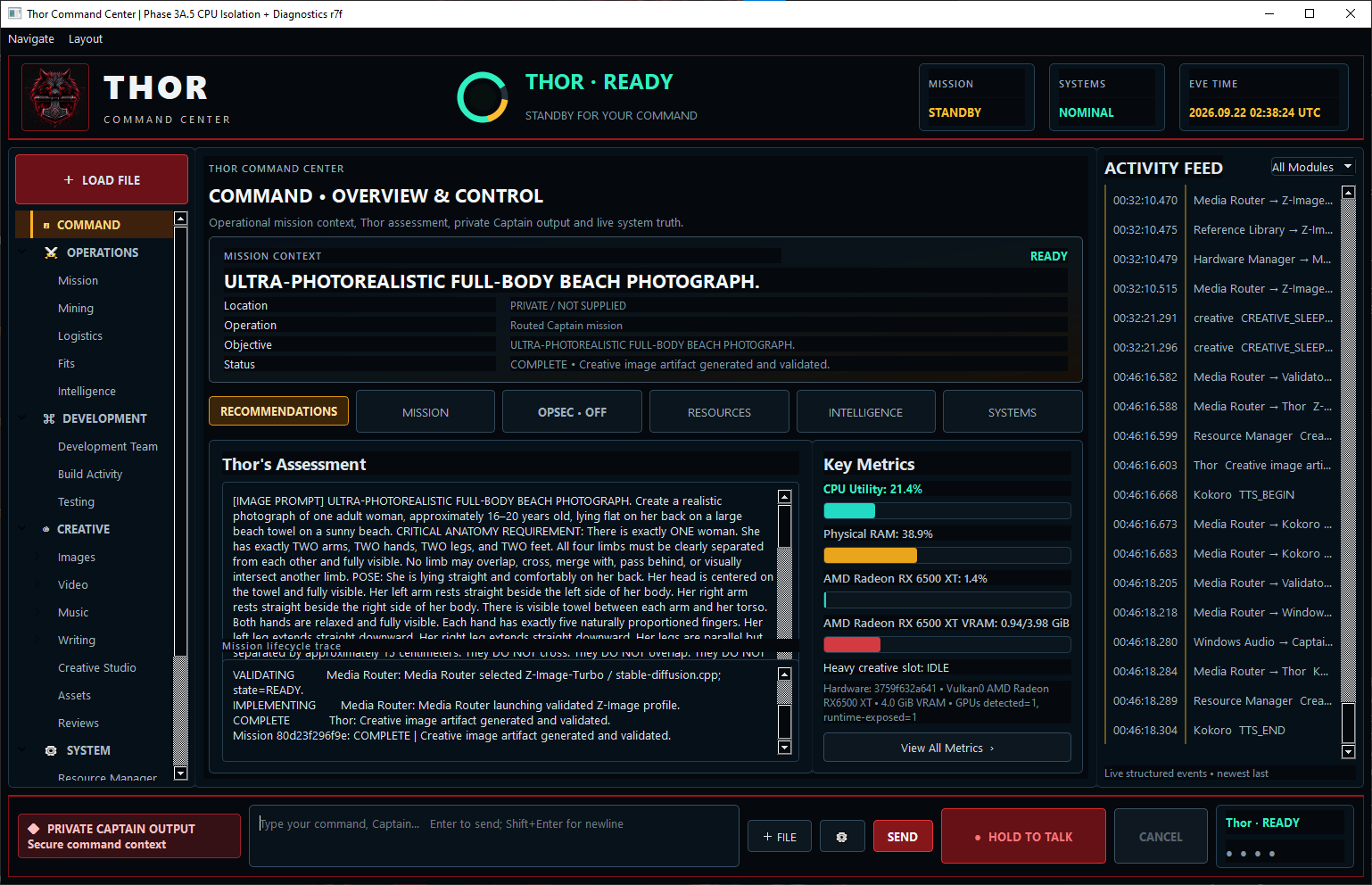
This is the functional system, not a speculative mockup. The Command Center is live and working while its visual design continues to evolve. It shows current mission context, Captain input, activity feed, creative routing, voice events, recommendations and live resource telemetry.
PROJECT STATUS · UPDATED SEPTEMBER 2026
Thor is ambitious, but the public story should not make a visitor guess what already works and what still belongs to the engineering roadmap.
The current Command Center is functional today, with mission context, Captain input, activity feed, recommendations, specialist routing, voice events and live system state.
Thor is designed around intent rather than prompt-engineering syntax. Human shorthand, imperfect grammar and conversational instructions are normalized into strict internal structures.
Thor coordinates local reasoning models, specialist roles, deterministic controls and supporting services from one Captain-facing environment.
Creative missions can route through the Creative Director, Media Router and the current local image-generation path.
The current voice path includes Kokoro service integration, Captain-facing speech normalization and streaming-mode output controls.
Thor detects host hardware, monitors CPU and RAM, treats GPUs and VRAM individually, manages heavy creative capacity and releases resources after workloads complete.
The working UI reports CPU, RAM, GPU, VRAM, runtime hardware context and heavy creative slot state in real time.
The image teaching domain is physically authored and sliced for retrieval. As of September 20, 2026: 42 planned image lessons, 51 completed guides including 9 shared guides, and 511 named section slices.
Thor is being connected so the right offline lessons can be selected automatically and injected into the active task instead of relying on manual reference selection.
The image curriculum is complete; planned Video, Music/Audio, Coding and Writing teaching domains are still being expanded.
The public end state is a local AI environment ordinary users can install and operate without becoming AI engineers.
Thor is designed to adapt to the machine it is given. Qualification across a wider range of consumer hardware remains part of the release path.
Thor's hardware-adaptive architecture can scale onto stronger dedicated AI hardware without changing the Captain-facing experience.
Current development models are staging components. Thor's long-term architecture includes replacing components that cannot meet the project's provenance standard.
Video, audio, writing and richer multimodal creation are intended to become first-class local capabilities as the teaching and runtime stacks mature.
Thor is broader than one model. It coordinates models, deterministic logic, specialist roles, local knowledge, tools, voice, creative generation, development workflows, resource management and project state while keeping the Captain-facing experience coherent.
Natural language, intent and final authority
Maintains context, interprets intent and routes the mission
Offline teaching knowledge selected for the task
Architect, Creative Director, development, voice and focused services
Contracts, contradiction checks, authority boundaries and release gates
Models and tools selected around the hardware actually available
One operating surface for missions, state, output and system health
SPECIALIST LANE
Creative work is routed through a focused path that can combine local generation, media routing and task-specific teaching instead of asking one model to improvise every step.
SPECIALIST LANE
Thor separates reasoning, review and code modification behind explicit authorization gates so development logic can be tested independently from file-changing authority.
OFFLINE TEACHING ARCHITECTURE
Thor's Rule Library is an offline curriculum, not just a folder of Markdown files. It is designed to teach how things are constructed, why they work, what failure looks like and how to improve the result.
Quick Digests can provide focused guidance when a task needs speed. Full Detail lessons can provide deeper construction knowledge when the mission needs more context.
Natural language, no schema memorization required
↓Context and mission meaning are normalized internally
↓Quick Digest or Full Detail knowledge is selected for the task
↓Focused construction knowledge reaches the active runtime
↓The same teaching knowledge can help inspect failure and guide repair
The image domain is fully authored and sliced. A total of 148 planned guides remain across Video, Music/Audio, Coding and Writing. Automatic runtime lesson retrieval is still in development, so these counts describe a real local knowledge base, not a claim that every current generation already invokes it automatically.
BUILT TOWARD CREATOR-RESPECTFUL AI
Thor is being designed so its finished creative system does not depend on taking creators' proprietary work without permission. Its offline teaching architecture focuses on documented instruction, first principles, permission-compatible sources and references intentionally provided by the user.
Current development models are staging components, not the final provenance architecture. Thor's long-term plan includes replacing components that cannot meet the project's provenance standard.
Thor is being taught how things are constructed, why they work, how they fail and how to repair them before relying on surface imitation.
Thor's own curated teaching and reference materials are built around provenance-aware, permission-compatible sources and intentionally supplied user references.
Internet research can enhance a task when the user chooses it, but the long-term goal is for Thor to carry useful local knowledge without requiring permanent cloud access.
Current development models are staging components, not the final provenance architecture. Components that cannot meet Thor's intended provenance standard are candidates for replacement.
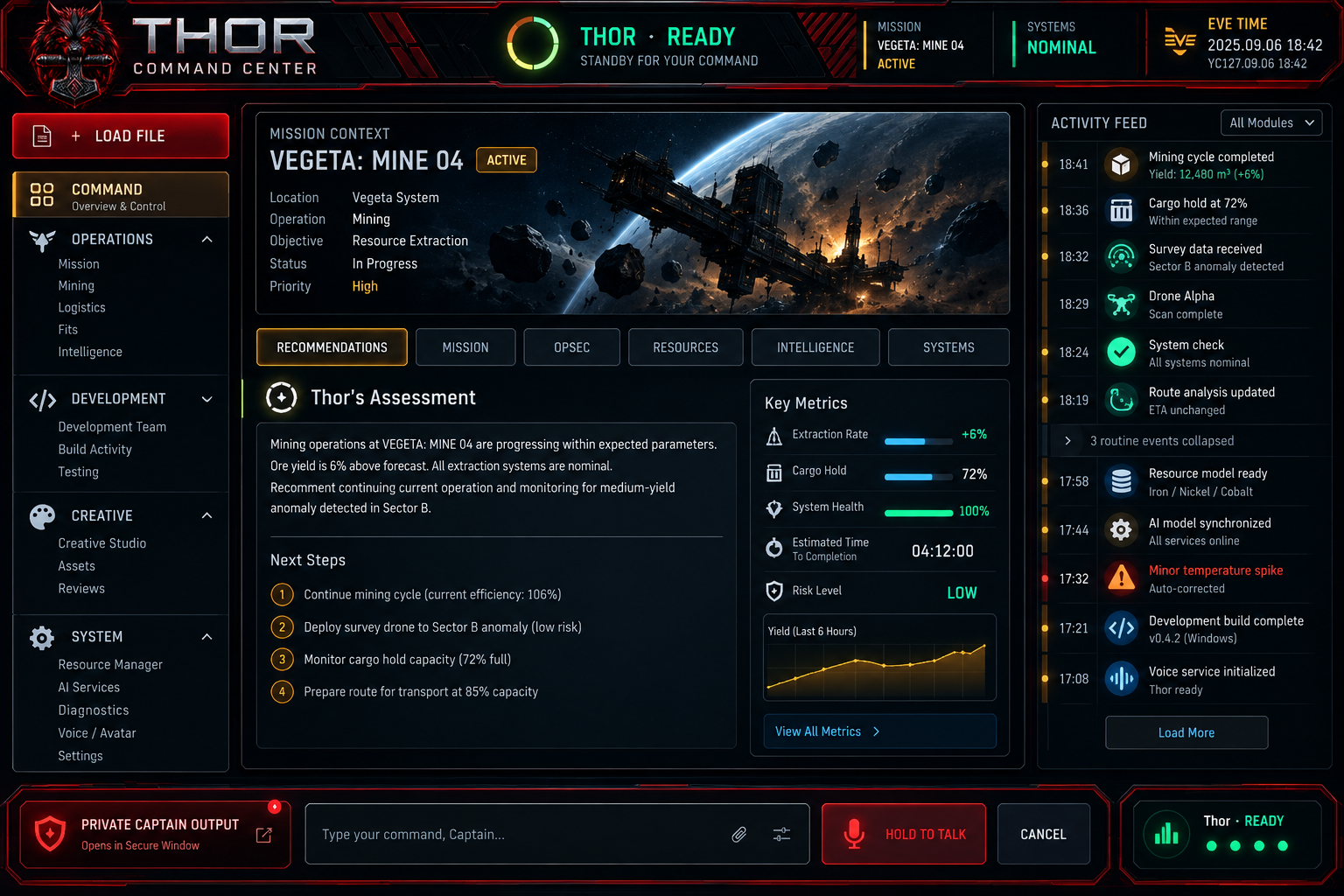
REAL-WORLD TEST CASE
EVE Online gives Thor a hard live environment full of changing information, operational context, private and public boundaries, resource decisions, voice interaction, tool routing, recommendations, status monitoring, streaming concerns and OPSEC.
If Thor can remain useful there while gaming, streaming and local AI services compete for the same machine, the underlying capabilities can transfer far beyond gaming.
BUILT UNDER CONSTRAINTS
Thor began on an aging machine with a 4 GB Radeon RX 6500 XT, limited finances and no assumption of huge VRAM or permanent cloud credits. Those limitations became architectural requirements.
Thor monitors CPU, RAM, GPU and VRAM, treats multiple GPUs individually rather than pretending their memory is one pool, acquires heavy creative capacity when a task needs it and releases that capacity when the work is complete. Idle Thor does not intentionally reserve a large GPU footprint.
Thor already runs locally on a 4 GB Radeon RX 6500 XT. NVIDIA's dedicated AI hardware and mature local-AI ecosystem represent a much larger performance ceiling for the architecture to explore.
Local-first does not mean isolated forever. Optional connected capabilities can be used when the Captain chooses them, while local execution and local reference knowledge remain available without a permanent cloud dependency.
FUTURE DIRECTION
The finished system should reduce the technical and financial barriers to serious AI work. Better hardware should raise the ceiling, not become the entrance fee.
Complete automatic selective Rule Library retrieval and continue Captain-led validation of how focused teaching changes creative output.
Finish the planned Video, Music/Audio, Coding and Writing teaching domains and connect them to the same task-focused retrieval architecture.
Move toward one-click consumer deployment, broader hardware qualification and a smoother local setup that does not assume AI engineering expertise.
Develop a provenance-controlled model strategy and replace development-stage dependencies that cannot satisfy Thor's completed-system standard.
User data and local knowledge can stay on the user's machine when local tools are used, without a per-prompt credit meter.
Thor can recommend, coordinate and execute bounded work, but the human remains Captain.
Thor's completed creative architecture is being built around instruction, permission, ownership and intentional references so creative AI expands what people can make without hiding where its knowledge came from.